The Titan Pro uses the ProOne flushing system, which is designed to move solid waste efficiently while providing a good bowl rinse. It is made of vitreous china, a durable ceramic material commonly used in quality bathroom fixtures.
One of the standout features of the Titan Pro is its flushing mechanism. The one-piece model features a 3-inch flush valve and a 2-1/8-inch fully glazed trapway. These components work together to move waste through the bowl using 1.6 gallons of water per flush.
In this American Standard Titan toilet review, we’ll discuss its flushing performance, design, comfort, installation, common problems, warranty, and the features that make it different from other American Standard toilets.
American Standard Titan Toilet Review 2026: Features and Specifications
American Standard has manufactured several Titan toilet configurations over the years, and their specifications are not necessarily identical.
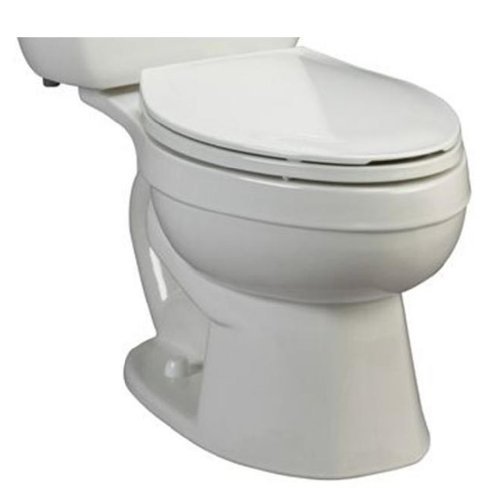
The Titan Pro one-piece model covered in this review features an elongated bowl, chair-height seating, ProOne flushing technology, and a 12-inch rough-in.
For homeowners who prioritize a strong flush, the Titan Pro offers a practical design. However, its 1.6 GPF consumption is higher than that of newer 1.28 GPF WaterSense-labeled toilets.
Technical Specifications: Titan Pro One-Piece Toilet
| Feature | American Standard Titan Pro |
|---|---|
| Reference Model | 2782016.020 |
| Toilet Type | One-piece |
| Bowl Shape | Elongated |
| Material | Vitreous china |
| Water Consumption | 1.6 GPF / 6.0 LPF |
| Flushing Technology | ProOne gravity-fed flushing system |
| Flush Valve | 3-inch, chlorine-resistant flapper |
| Trapway | 2-1/8 inches, fully glazed |
| Bowl Design | Elongated dual water-jet feed |
| Rim Height | 16-1/8 inches without seat |
| Trip Lever | Side-mounted |
| Rough-In | 12 inches |
| WaterSense | No, 1.6 GPF model |
| Warranty | 10-year limited warranty |
| Product Status | Discontinued |

These specifications apply to model 2782016.020. Earlier Titan two-piece toilets and other Titan configurations may have different dimensions, flushing parts, and warranty conditions.
If you’re shopping for an alternative, our American Standard toilet buying guide covers additional models and configurations.
How Well Does the American Standard Titan Pro Flush?
The American Standard Titan Pro was designed to deliver effective waste removal with a single-flush mechanism. Its ProOne system directs water through the bowl to create siphon action and move waste into the drain.
The 3-inch flush valve allows water to enter the bowl quickly, while the 2-1/8-inch fully glazed trapway helps reduce resistance as waste passes through.
The toilet also has an elongated dual water-jet feed bowl designed to support effective flushing and bowl rinsing.
One thing I like about this design is that it does not rely on a complicated electronic or dual-flush mechanism. The gravity-fed flushing system is relatively straightforward to understand and maintain.
However, no toilet is completely clog-proof. Excess toilet paper, wipes, foreign objects, or a partially blocked drain can still cause flushing problems.
Benefits of Using the American Standard Titan Pro Toilet
There are several reasons why the Titan Pro has appealed to homeowners who want a durable toilet with reliable flushing performance.
- Strong flushing performance: The ProOne system is designed to move household waste efficiently.
- Durable construction: Vitreous china resists moisture and is suitable for years of normal bathroom use.
- Elongated comfort: The elongated bowl provides more sitting room than a typical round-front bowl.
- Accessible-height design: The 16-1/8-inch rim height makes sitting and standing easier for many adults.
- Large flush valve: The 3-inch valve supports fast water delivery into the bowl.
- Glazed trapway: The 2-1/8-inch passage is designed to move waste smoothly.
- One-piece construction: Fewer exterior seams make the fixture easier to wipe down.
- Common rough-in: A 12-inch rough-in is compatible with many existing residential bathroom layouts.
- Extended footprint: The design can help cover marks left by certain previously installed toilets.
- Warranty: The manufacturer originally specified a 10-year limited warranty.
What Are the Setbacks of the Titan Pro Toilet?
The Titan Pro also has a few disadvantages worth considering before buying.
- Discontinued model: New stock and compatible replacement parts may become harder to find.
- Higher water consumption: At 1.6 GPF, it uses more water than comparable 1.28 GPF models.
- Not WaterSense-labeled: The model does not meet the EPA WaterSense maximum flush-volume requirement.
- Heavy fixture: Its one-piece construction can make installation more difficult for one person.
- Single-flush design: There is no separate reduced-volume flush for liquid waste.
- Seat and installation materials: Confirm what is included in any remaining-stock package before purchasing.
Water-efficiency requirements also vary by state and local jurisdiction. A 1.6 GPF toilet may not meet the rules that apply to new installations or replacement toilets in certain locations.
For that reason, verify current local plumbing requirements rather than assuming a discontinued Titan Pro can be installed anywhere in the United States.
American Standard Titan Pro Round vs. Elongated Toilets
Toilet bowl shape makes a difference in everyday comfort. An elongated toilet generally provides more sitting space, while a round-front design can fit more easily into a compact bathroom.
The Titan Pro 2782016.020 is an elongated model. If your bathroom has limited space in front of the toilet, measure carefully before purchasing.
Some older Titan products and retailer listings may use slightly different model descriptions. Do not assume that every product advertised as a Titan Pro has the same bowl shape, overall dimensions, or included accessories.
American Standard Titan Two-Piece Toilet Review
The original Titan range also included two-piece configurations. With a two-piece toilet, the tank and bowl are separate components that are connected during installation.
Some homeowners prefer this design because the tank and bowl can be carried separately. This makes installation easier in bathrooms with narrow doorways or stairs.
Two-piece toilets may also allow a damaged tank or bowl to be replaced individually, provided the matching component remains available.
However, you should not use the 2782016.020 one-piece specifications to select parts for a different Titan two-piece toilet.
What to Check on a Titan Two-Piece Model
Before purchasing or repairing a two-piece Titan, identify its exact product number. Check the markings inside the tank and any original paperwork.
Pay particular attention to the flush valve, trapway, flush volume, tank-to-bowl hardware, and toilet seat requirements. These features may differ across the Titan range.
| Feature | Titan Pro One-Piece 2782016 | Older Titan Two-Piece |
|---|---|---|
| Construction | Integrated tank and bowl | Separate tank and bowl |
| Flushing System | ProOne | Verify exact model |
| Flush Volume | 1.6 GPF | Model-dependent |
| Flush Valve | 3 inches | Verify tank specifications |
| Trapway | 2-1/8 inches | Verify bowl specifications |
| Bowl Shape | Elongated | Depends on version |
| Installation | Single heavy fixture | Tank and bowl installed separately |
| Maintenance | No external tank-to-bowl seal | Tank-to-bowl gasket requires maintenance if it leaks |
| Replacement Parts | Use 2782016-compatible parts | Match exact tank and bowl numbers |
If you’re unsure which design is better for your bathroom, read our one-piece vs. two-piece toilet comparison.
American Standard Titan Toilet: Common Problems and Troubleshooting
Even a well-built toilet can develop issues over time. Most problems involve the fill valve, flush valve, water supply, or drain rather than the vitreous china body.
The table below covers common symptoms and the first things worth checking.
| Issue | Possible Cause | What to Do |
|---|---|---|
| Weak flush | Low tank water level, partial clog, or flushing mechanism problem | Check the tank water level and handle linkage. Clear any suspected trapway blockage using a toilet plunger. |
| Water leaking at base | Failed floor seal, damaged flange, or loose mounting hardware | Inspect the toilet base. Replace the floor seal if needed and avoid overtightening the bolts. |
| Toilet keeps running | Worn flapper, dirty sealing surface, or fill valve problem | Inspect the flapper and tank water level. Clean or replace defective parts. |
| Slow tank refill | Restricted shutoff valve, blocked fill valve, or low water pressure | Check the supply valve and line. Clean or replace the fill valve as appropriate. |
| Bowl water level too low | Disconnected refill tube or drainage problem | Check that the refill tube directs water into the overflow pipe. Investigate continuing water loss. |
| Toilet rocks on floor | Uneven floor, loose mounting hardware, or damaged flange | Check the floor and flange. Use suitable toilet shims and reseal the fixture if it must be lifted. |
1. American Standard Titan Toilet Has a Weak Flush
If the Titan toilet is not flushing as strongly as it used to, start by checking the water level inside the tank.
Low tank water levels can reduce the amount of water available during flushing. A partial blockage in the trapway or drain may also cause slow waste removal.
Inspect the flush handle and chain to make sure the flapper opens correctly. If everything appears normal, use a flange-style toilet plunger to clear a suspected blockage.
For additional troubleshooting, see our guide on why a toilet won’t flush properly.
2. Water Leaks Around the Toilet Base
If water appears around the base after flushing, a damaged wax ring or floor seal could be responsible.
First, dry the area and inspect the water supply connection. A leaking supply line can sometimes make it appear that the floor seal is defective.
If the water is coming from beneath the bowl, the toilet may need to be removed and a new floor seal installed.
Do not simply tighten the closet bolts as much as possible. Excessive force can crack the ceramic base.
3. Titan Pro Toilet Keeps Running
Continuous running is often caused by a worn flapper, mineral deposits on the sealing surface, or a fill valve that does not shut off.
Remove the tank lid and check whether water is entering the overflow tube. If it is, adjust or repair the fill valve.
If the water level is below the overflow tube but the tank continues losing water, inspect the flapper seal.
Our guide on how to fix a running toilet explains these checks in more detail.
4. Slow Tank Refilling
A slow-filling tank is commonly caused by restricted water flow or buildup inside the fill valve.
Make sure the toilet shutoff valve is fully open. Check the supply line for kinks or damage.
If the water pressure is normal but the tank still fills slowly, the fill valve may require cleaning or replacement.
When replacing a fill valve, choose a component compatible with the tank and follow the manufacturer’s installation instructions.
5. Bowl Doesn’t Refill Properly
If the water level inside the bowl remains unusually low after flushing, inspect the refill tube inside the tank.
The refill tube should direct water into the overflow pipe according to the fill valve manufacturer’s instructions.
A disconnected or improperly positioned tube may prevent enough water from returning to the bowl.
If the refill system is working correctly but the bowl still loses water, investigate possible drainage or venting problems.
American Standard Titan Pro Toilet Installation Guide
The Titan Pro one-piece toilet uses a standard 12-inch rough-in and is designed for floor-mounted installation.
Its integrated tank and bowl can simplify some installation steps, but the complete fixture is heavy. You should have another person assist when lifting it into position.
Step 1: Check the Rough-In and Floor
Measure the distance from the finished wall behind the toilet to the center of the drain or closet bolts.
Make sure the rough-in matches the selected toilet. Inspect the floor flange for cracks and confirm that the floor provides stable support.
Step 2: Prepare the Toilet Seal
Remove the old toilet if necessary and clean the area around the flange.
Position a new wax ring or compatible wax-free seal according to its instructions. Make sure the closet bolts are aligned correctly.
Step 3: Install the Toilet
With assistance, lift the one-piece fixture and align it over the flange and bolts.
Lower the toilet carefully without disturbing the floor seal. Secure it evenly and avoid overtightening the mounting hardware.
Step 4: Connect the Water Supply
Connect the supply line to the fill valve and shutoff valve. Open the supply slowly and allow the tank to fill.
Check for leaks around the water connections.
Step 5: Test the Flush
Flush the toilet several times. Confirm that the bowl clears properly, refills to its normal level, and the tank stops filling after each flush.
Inspect the floor and supply connections again for leaks before completing the installation.
Important: These are general installation steps. Use the specific installation instructions supplied with your Titan model, and follow applicable local plumbing requirements.
American Standard Titan vs. Cadet 3 Comparison
American Standard Titan and Cadet 3 toilets are designed for different buyer priorities.
The Titan Pro emphasizes strong flushing performance and a durable fixture design. Cadet 3 toilets are available in several configurations, including water-efficient 1.28 GPF models.
Since Cadet 3 is a product family rather than a single toilet, specifications vary by model. The following table compares the reviewed Titan Pro with common Cadet 3 options.
| Feature | American Standard Titan Pro 2782016 | Cadet 3 Family |
|---|---|---|
| Construction | One-piece | One-piece or two-piece |
| Water Consumption | 1.6 GPF | 1.28 or 1.6 GPF, depending on model |
| Bowl Shape | Elongated | Round or elongated |
| Flush System | ProOne | Cadet flushing system |
| Flush Valve | 3 inches | Typically 3 inches on Cadet 3 models |
| Trapway | 2-1/8 inches | Varies by model |
| Rim Height | 16-1/8 inches | Standard or chair-height options |
| Rough-In | 12 inches | Varies by model |
| WaterSense Option | No | Yes, specified 1.28 GPF models |
| Seat Included | Verify package | Depends on model |
| Availability | Discontinued | Depends on selected model |
| Best For | Existing owners and remaining-stock buyers seeking strong flushing | Buyers who want more configuration and efficiency choices |
If you want a new toilet and care about saving water, a 1.28 GPF Cadet 3 model may be the more practical choice.
You can explore these models in our American Standard Cadet 3 review.
American Standard Titan vs. Champion 4: Which Is Better?
The Titan Pro and Champion 4 are both associated with strong flushing performance, but their flushing systems differ.
The Titan Pro 2782016 uses a 3-inch flush valve and 2-1/8-inch trapway. The Champion 4 one-piece 1.6 GPF model uses a 4-inch Accelerator flush valve and 2-3/8-inch trapway.
Those larger openings are part of the Champion 4’s design for high bulk-waste removal performance. However, flush valve and trapway dimensions alone do not guarantee that one toilet will outperform another in every household.
If you prioritize a large waste passage and strong flushing, the Champion 4 may be more appealing. If you already own a Titan Pro that works well, replacing it solely because another model has a larger flush valve may not be necessary.
For more details, see our Titan vs. Champion 4 comparison.
Is the American Standard Titan Pro Still Worth Buying in 2026?
The Titan Pro can still be a dependable toilet for homeowners who already own one. Its vitreous china construction, straightforward flushing mechanism, and comfortable elongated bowl are useful features.
However, buying a discontinued toilet requires additional care.
You should confirm that the product is new and undamaged, that the correct installation materials are available, and that compatible replacement parts can still be obtained.
It’s also important to consider water consumption. The 1.6 GPF Titan Pro uses more water than a modern 1.28 GPF toilet.
For example, at five flushes per day, switching from 1.6 GPF to 1.28 GPF saves approximately 584 gallons of water per person annually. Actual savings depend on household use.
If you’re buying a toilet for a new bathroom or replacing an old one, comparing currently available WaterSense-labeled models is a sensible next step.
Final Thoughts on the American Standard Titan Toilet
The American Standard Titan Pro was designed to offer dependable flushing, durable construction, and comfortable seating. Its ProOne flushing system, 3-inch flush valve, and fully glazed trapway help it handle everyday household waste.
Its one-piece design is also convenient for exterior cleaning, while the elongated bowl provides more seating space than a round-front design.
However, the Titan Pro model reviewed here has been discontinued. Its 1.6 GPF water consumption is another drawback when compared with modern high-efficiency toilets.
For existing owners, the Titan Pro can remain a practical toilet as long as it functions properly and compatible repair parts are available.
For new buyers, I would compare it with currently available American Standard Cadet and Champion models before making a final decision.
Overall, this American Standard Titan toilet review shows that the Titan Pro has useful features, but its age, availability, and water consumption are important considerations in 2026.
Frequently Asked Questions About the American Standard Titan Toilet
1. Is the American Standard Titan Pro toilet discontinued?
Yes. American Standard lists the Titan Pro Right Height Elongated One-Piece Toilet, model 2782016, as discontinued. You may still find remaining inventory through some sellers, but availability is not guaranteed.
2. How much water does the Titan Pro use per flush?
The Titan Pro 2782016 uses 1.6 gallons of water per flush. This meets the federal maximum for residential toilet flush volume but does not qualify for EPA WaterSense labeling.
3. Does the American Standard Titan Pro have a powerful flush?
The ProOne flushing system uses a 3-inch flush valve and a 2-1/8-inch glazed trapway to move household waste. It is designed for effective flushing, although actual performance can be affected by blockages, water level, and drain conditions.
4. Can I replace the Titan Pro toilet flapper?
Yes, a worn flapper can generally be replaced. However, use a flapper designed for the correct flush valve size and model. Check the manufacturer’s repair-parts information before ordering.
5. Is the Titan Pro suitable for an accessible bathroom?
The 2782016 model has a 16-1/8-inch bowl rim and was designed for accessible applications. However, the complete installation must meet applicable accessibility requirements, including the finished seat height, fixture location, clearance, and grab bars.
6. Should I buy a Titan Pro or a newer Cadet 3 toilet?
If you want a new toilet with better water efficiency and wider model availability, a current 1.28 GPF Cadet 3 is generally the more practical option. A Titan Pro may still make sense if you find suitable remaining stock and specifically prefer its design.

Hi, this is Robert Crossan, the owner of this website, has 17 years of experience in the installation, maintenance, and repair of toilets and plumbing systems. After completing the Level 2 Basic Plumbing course in 2005, I started working in both domestic and commercial buildings as a professional plumber. So I can figure out the core difference between different toilet models and brands. It also helped me monitor their work performance and setbacks.
what size of wax ring is used- we continue to have a sewer smell
You should use a standard size wax ring. And don’t use double(two) wax ring. It could be a reason for leaking. Raise the flange to solve this leaking issue.
Why do you list as 1.6 gpf and also as 1.28 gpf? Which is it?
It will be 1.6GPF.(corrected the article)
My 3yr old can clog this toilet. The flush is excessively weak. I’m not sure if I’m missing an adjustment but 2/2 of titan toilets are very poor at flushing.
The problem is NOT the toilet but the drain. Over the years the drain can close to a smaller diameter wih a constant coating of feces and that hardens like a brick reducing the vacuum effect of the flush. You may also have a toy/diaper etc blockage also.
My toilet is only 4 months old and has clogged 2 times now requiring a plumber! There are only 2 adults living in the house and minimum usage. I would never purchase this toilet again!
What cleaning product do you use for the seat, toilet bowl and the out side toilet
I recommend a mild gel-based soap or dish soap.
Do not use anything abrasive that would scratch the surface. And also, do not use any harsh cleaners or strong acids or bases.
Hello – According to the most recent technical specifications from American Standard, the flushing system is THE SAME as the Champion 4. “Industry-leading clog resistance with a 4″ non-adjustable, piston action Accelerator flush valve and a 2-3/8″ fully-glazed trapway”. Just thought people may want to know or if you were on the fence like I was. Flush system and trapway seem to be identical at a little bit better price point for the Titan.
Champion4 Max has a current history of cracking. What about the Titan?
Sever problem with flapper dropping down to stop water flowing. Gets hung up sometimes and fails to cover drain opening.
I find this toilet is good at flushing solid waste, but worthless at flushing toilet paper that doesn’t hit the water. I.E. throwing paper to the front of bowl for a female. Virtually no water comes from the top of the bowl to push these down into the impressive force of the front flush.
Can I replace the tank of an eljer titan with the tank of an American Standard toilet instead of replacing the whole toilet?
Yes, If the tank size is identical.