One-piece and two-piece toilets have many things in common. Both serve the same purpose, use similar plumbing connections, and can offer excellent flushing performance. Depending on the model, either type may use 1.28 or 1.6 gallons per flush.
But when comparing one piece vs two piece toilets, which is better for your bathroom?
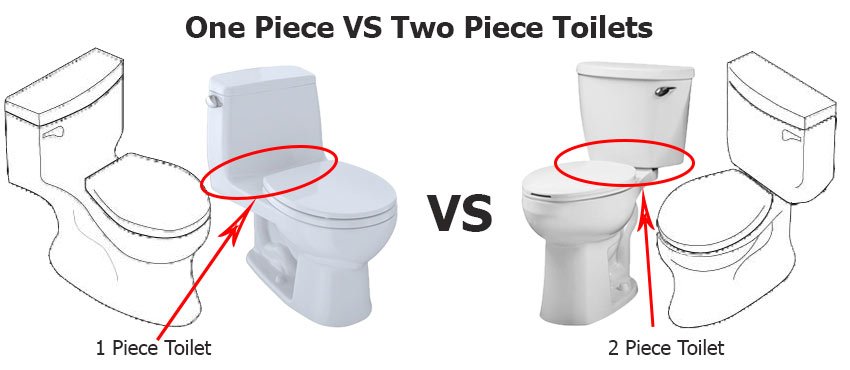
The biggest difference is their construction. A one-piece toilet combines the tank and bowl into a single ceramic fixture, while a two-piece toilet has a separate tank that connects to the bowl.
Both designs have advantages and disadvantages. One-piece toilets are generally easier to clean and have a sleek appearance. Two-piece toilets are often more affordable, easier to transport, and simpler to handle during installation.
Let’s compare their size, durability, cleaning, installation, maintenance, and cost to help you choose the right toilet.
What Is the Difference Between One-Piece and Two-Piece Toilets?
A one-piece toilet has a tank and bowl manufactured as one continuous ceramic unit. This eliminates the separate tank-to-bowl joint found on traditional two-piece toilets.
A two-piece toilet has two main sections: the bowl and a removable tank. These are joined during installation using bolts and a sealing gasket.
Both designs can provide reliable flushing, and neither is automatically more water-efficient.
You can explore additional models in our one-piece toilet buying guide and compare them with our two-piece toilet reviews.
One Piece vs Two Piece Toilets: Comparison Chart
| Feature | One-Piece Toilet | Two-Piece Toilet |
|---|---|---|
| Construction | Integrated tank and bowl | Separate tank and bowl |
| Cleaning | Generally easier around the tank | Additional joint requires cleaning |
| Installation | Heavier single unit | Parts can be lifted separately |
| Purchase Price | Often higher | Often more affordable |
| Flushing Performance | Depends on model | Depends on model |
| Durability | Long-lasting with proper care | Long-lasting with proper care |
| Tank-to-Bowl Leak | No separate tank-to-bowl joint | Gasket or bolts can develop leaks |
| Replacement | Integrated ceramic unit | Tank or bowl may be replaceable separately |
| Shipping | Bulky single fixture | Often packaged in separate sections |
| Bathroom Space | Depends on dimensions | Depends on dimensions |
| Seat Height | Standard and taller options | Standard and taller options |
| Maintenance Cost | Depends on repair | Depends on repair |
Advantages and Disadvantages of One-Piece Toilets
One-piece toilets have become popular because of their clean appearance and integrated construction.
Advantages of One-Piece Toilets
- Easy to clean: No separate tank-to-bowl joint where dust and grime can collect.
- Modern appearance: The seamless design looks attractive in many bathrooms.
- Fewer external connections: No separate tank-to-bowl gasket or connecting bolts.
- Compact options: Some models offer a low-profile or compact elongated design.
- Durable construction: Quality vitreous china models can last for many years.
Disadvantages of One-Piece Toilets
- They often cost more than comparable two-piece toilets.
- The entire ceramic fixture must be lifted during installation.
- Shipping and handling can be more difficult because of the weight.
- A damaged integrated ceramic tank or bowl may require replacing the whole fixture.
- Some specialized models have fewer compatible replacement parts.
Advantages and Disadvantages of Two-Piece Toilets
Two-piece toilets remain a practical choice for many homeowners. Their traditional construction provides flexibility during installation and maintenance.
Advantages of Two-Piece Toilets
- Affordable options: Many budget-friendly models are available.
- Easier handling: The tank and bowl can be moved separately.
- Repair flexibility: Compatible tanks or bowls may sometimes be replaced individually.
- Wide selection: Different bowl shapes, heights, flushing systems, and rough-in dimensions.
- Common replacement parts: Many conventional models use widely available repair components.
Disadvantages of Two-Piece Toilets
- The joint between the tank and bowl requires occasional cleaning.
- Tank bolts and connecting gaskets can wear over time.
- Installation requires aligning and securing the tank correctly.
- An improperly installed tank may leak or move.
However, a properly installed two-piece toilet isn’t necessarily less reliable or more likely to break than a one-piece model.
One Piece vs Two Piece Toilets: Detailed Comparison
1. Size and Bathroom Space
Many homeowners assume a one-piece toilet is always smaller than a two-piece toilet. That’s not necessarily true.
Some one-piece toilets have compact, low-profile tanks, while others are similar in size to conventional two-piece models.
The overall depth depends largely on the bowl design and tank configuration.
For example, elongated bowls generally extend farther into the bathroom than round-front bowls.
If your bathroom is small, compare the actual dimensions rather than relying on the toilet’s construction type.
Our round vs elongated toilet comparison explains how bowl shape affects bathroom space and comfort.
2. Ease of Cleaning
One-piece toilets generally have an advantage when it comes to exterior cleaning.
Because the tank and bowl form a single fixture, there’s no separate joint where dust and dirt can accumulate.
Two-piece toilets have a gap around the tank-to-bowl connection that may require extra attention.
However, cleaning also depends on whether the toilet has a skirted trapway, smooth ceramic glaze, and accessible exterior surfaces.
A skirted two-piece toilet may actually be easier to wipe down than a one-piece toilet with a complicated exposed trapway.
Winner: One-piece toilets generally have the edge, although the exterior design matters.
3. Ease of Installation
Two-piece toilets are often easier to carry into a bathroom because the tank and bowl can be handled separately.
This is particularly helpful when working in a narrow bathroom or carrying the toilet upstairs.
One-piece toilets can be heavy and awkward to position over the floor flange.
However, they eliminate the additional step of attaching a separate tank.
Both designs require a properly installed drain seal, secure mounting, and leak testing.
Winner: Two-piece toilets for easier lifting and handling. The overall installation difficulty still depends on the model.
4. Durability
Both one-piece and two-piece toilets are commonly manufactured from vitreous china or other suitable sanitary ceramic materials.
With proper installation and maintenance, either type can last for decades.
One-piece toilets don’t have a separate tank-to-bowl gasket, eliminating one potential maintenance issue.
However, they can still develop cracks, worn flush valve seals, fill valve problems, or leaks around the floor connection.
Two-piece toilets are also durable when their components are correctly installed.
Winner: Neither automatically. Manufacturing quality and maintenance matter more.
5. Flushing Performance and Water Usage
The flushing performance of a toilet depends primarily on the bowl, trapway, flush valve, and overall hydraulic design.
Both one-piece and two-piece toilets can use gravity-fed, pressure-assisted, or dual-flush systems, depending on the model.
Many modern toilets use 1.28 GPF, while others use 1.6 GPF or different water volumes.
A high-quality 1.28 GPF toilet can flush effectively without needing more water.
Our 1.28 vs 1.6 GPF toilet comparison explains the differences in water consumption and performance.
Winner: Depends on the specific toilet, not its construction.
6. Leaks and Maintenance
One-piece toilets have fewer exterior connections because the tank and bowl are integrated.
Two-piece toilets have a tank-to-bowl gasket and bolts that may eventually require attention.
However, both types use flush valves, fill valves, supply connections, and floor seals that can develop problems over time.
In some cases, a two-piece toilet offers an advantage because an individual compatible tank or bowl can be replaced.
Winner: One-piece for fewer tank connections; two-piece for potential ceramic component replacement flexibility.
7. Purchase Price and Shipping
One-piece toilets often cost more because of their manufacturing process, appearance, and product positioning.
Two-piece toilets are widely available in affordable configurations.
Shipping also differs. Two-piece toilets can often be packaged and transported in separate boxes, while one-piece toilets require careful handling of a single large ceramic unit.
However, premium two-piece toilets can cost more than basic one-piece models.
Winner: Two-piece toilets generally offer more budget-friendly choices.
Best One-Piece Toilets Worth Considering
If you prefer easier exterior cleaning and a seamless appearance, here are some established one-piece models worth comparing.
1. TOTO UltraMax II MS604114CEFG
The TOTO UltraMax II combines an elongated bowl with an integrated tank and a modern flushing system.
- One-piece construction.
- 1.28 gallons per flush.
- Tornado Flush technology.
- CEFIONTECT ceramic glaze on applicable finishes.
- Universal Height design.
- 12-inch rough-in.
- WaterSense certified.
Its smooth ceramic finish and integrated construction make it a good choice for homeowners who want a relatively easy-to-clean toilet.
2. Kohler Santa Rosa K-3810
The Kohler Santa Rosa is another popular one-piece option with a compact elongated design.
- 1.28 GPF gravity flushing.
- AquaPiston canister technology.
- Comfort Height seating.
- Compact elongated bowl.
- 12-inch rough-in.
- Quiet-Close toilet seat included.
Its compact elongated design is worth considering when you want more seating room without a particularly long toilet.
Read our Kohler Santa Rosa review for more details.
3. TOTO Soiree
The TOTO Soiree is a distinctive one-piece toilet with a skirted design.
Depending on the exact model, it offers an elongated bowl, water-efficient flushing, and a smooth exterior that’s relatively easy to wipe clean.
Check the exact model number and current availability before purchasing.
View TOTO Soiree Product Details
Best Two-Piece Toilets Worth Considering
Two-piece toilets are a practical choice when you’re looking for affordable options, installation flexibility, and a wide range of replacement parts.
1. Kohler Highline
The Kohler Highline family includes several two-piece toilets with different flushing systems and bowl configurations.
Some models use conventional gravity flushing, while specific Highline models use pressure-assisted technology.
Water consumption and bowl height vary by model.
See our Kohler Highline toilet review for one configuration.
2. American Standard Optum VorMax
The American Standard Optum VorMax is another two-piece toilet worth considering.
Selected models use 1.28 GPF and feature the VorMax flushing design, which directs water around the bowl to support cleaning.
Check the exact product configuration for seat inclusion, height, and availability.
3. Kohler Memoirs
Kohler Memoirs toilets are known for their traditional styling.
The collection includes two-piece models with elongated bowls, decorative tank shapes, and different flushing specifications.
It’s a suitable option if you prefer a classic bathroom appearance over a minimalist design.
4. TOTO Aquia II
The TOTO Aquia II is a two-piece toilet with an elongated bowl and dual-flush technology.
The original Aquia II configuration uses approximately 0.9 GPF for a reduced flush and 1.6 GPF for a full flush.
It also features a semi-skirted design that gives the toilet a relatively smooth appearance.
For additional details, read our TOTO Aquia II review.
Remember that older models may no longer be widely available, and specifications can differ between newer and discontinued versions.
Which Toilet Should You Buy: One-Piece or Two-Piece?
After comparing one piece vs two piece toilets, my preference depends on your bathroom and budget.
Choose a one-piece toilet if:
- You want a seamless, modern design.
- Easy exterior cleaning is a priority.
- You prefer eliminating the separate tank-to-bowl joint.
- Your budget allows for a higher purchase price.
Choose a two-piece toilet if:
- You want more affordable options.
- You need to carry the toilet through tight spaces or upstairs.
- You prefer a traditional design.
- You want more flexibility when replacing compatible tank or bowl components.
Before buying either type, check the rough-in distance, bowl shape, toilet height, and flushing performance.
These details often make a bigger difference than the one-piece or two-piece construction itself.
Frequently Asked Questions
1. Are one-piece toilets better than two-piece toilets?
One-piece toilets are generally easier to clean around the tank and eliminate the separate tank-to-bowl joint. Two-piece toilets often cost less and are easier to transport. Neither type is automatically better for flushing performance or durability.
2. Do one-piece toilets flush better?
Not necessarily. Flushing performance depends on the flush valve, bowl, trapway, and overall design. A well-designed two-piece toilet can flush just as effectively as a one-piece model.
3. Do two-piece toilets leak more often?
They have an additional tank-to-bowl connection that can develop leaks if a gasket wears out or bolts become loose. However, a properly installed two-piece toilet can remain leak-free for many years.
4. Are one-piece toilets harder to install?
They can be harder to lift and position because the tank and bowl form one heavy unit. Two-piece toilets allow the tank and bowl to be handled separately, although the tank must be connected during installation.
5. Which toilet lasts longer, one-piece or two-piece?
Both can last for decades when manufactured properly and maintained well. Ceramic quality, installation, water conditions, and maintenance are generally more important than the construction type.
6. Which toilet is better for a small bathroom?
Either can work. Some one-piece models offer compact designs, but a compact two-piece toilet may fit just as well. Compare overall depth, width, bowl shape, and required clearances before purchasing.
Final Thoughts
So, which is better when comparing one piece vs two piece toilets?
If you prefer a modern appearance, easy exterior cleaning, and fewer tank connections, a one-piece toilet may be the better choice.
If affordability, easier handling, and replacement flexibility are more important, a two-piece toilet is an excellent option.
Both types can provide reliable flushing, good water efficiency, and long-lasting performance when you choose a quality model.
My suggestion: Don’t pay extra for a one-piece toilet simply because it looks more advanced. Compare the actual specifications, bathroom dimensions, flushing performance, and warranty before deciding.
The best toilet isn’t necessarily the most expensive or the most modern-looking one. It’s the model that fits your bathroom, works reliably, and stays within your budget.

Hi, this is Robert Crossan, the owner of this website, has 17 years of experience in the installation, maintenance, and repair of toilets and plumbing systems. After completing the Level 2 Basic Plumbing course in 2005, I started working in both domestic and commercial buildings as a professional plumber. So I can figure out the core difference between different toilet models and brands. It also helped me monitor their work performance and setbacks.
Thanks, I got a lot of good information, need to buy a replacement tomorrow. I will be going for a 1 piece. Unless I find a water closet, which was in this house from 1920 to 1940’s.
I’m grateful for your advice about getting a toilet. My sister is now renovating their dining and kitchen rooms, while the bathrooms are next in line. She’s been asking if there is a possibility of replacing their toilets for each bathroom.