
Tankless toilets are becoming popular because they offer more than just a compact design. Many modern models combine powerful flushing, comfortable seating, and advanced features such as automatic flushing, warm-water cleansing, and heated seats.
However, choosing the right tankless toilet can be confusing. Some toilets have no conventional water tank, while others simply hide the tank inside the wall. They may look similar, but their installation requirements and flushing systems are different.
In our best tankless toilet reviews, I’ve selected 10 models worth comparing. These include genuine tankless systems, integrated smart toilets, and wall-hung alternatives that create a tankless appearance.
We’ll discuss their features, advantages, disadvantages, installation requirements, and maintenance considerations so you can choose a toilet that fits your bathroom and budget.
If you’re unsure whether this design is right for you, our tank vs. tankless toilet comparison explains the main differences.
What Is a Tankless Toilet, and How Does It Work?
A traditional toilet stores water in a tank and releases it when you flush. A tankless toilet uses a different arrangement.
Some genuine tankless models depend on a direct water connection and a flushing mechanism that operates without a conventional gravity tank. Other compact models use electric pumps or integrated systems.
There are also wall-hung toilets with concealed tanks. These hide the water tank behind the bathroom wall, creating a clean appearance without actually eliminating the tank.
Before buying, it’s important to understand which type you’re getting.
Three Common Tankless-Style Designs
- Direct-supply tankless toilets: Use a suitable water supply and specialized flushing system instead of a conventional gravity tank.
- Integrated smart toilets: Combine the toilet with electronic cleansing and automatic features. Their internal flushing arrangements vary.
- Concealed-tank wall-hung toilets: Have a hidden tank and carrier system installed inside the wall.
A toilet without a visible tank isn’t automatically a true tankless model. Always check the manufacturer’s specifications.
Best Tankless Toilet Reviews: Quick Comparison
| Toilet Model | Design | Best Considered For |
|---|---|---|
| TOTO Neorest 700H | Integrated smart toilet | Luxury features |
| KOHLER Veil K-5401 | Direct-supply smart toilet | Modern tankless bathrooms |
| Saniflo Sanicompact 023 | Tankless macerating toilet | Basements and difficult drainage |
| TOTO Neorest 550H | Integrated smart toilet | Premium comfort |
| WOODBRIDGE B0950S | Integrated smart toilet | Electronic bidet features |
| Bio Bidet IB835 | Integrated bidet toilet | Personal cleansing |
| TOTO Washlet G400 | Integrated smart toilet | Water-efficient flushing |
| KOHLER Veil K-6299 | Concealed-tank wall-hung | Small modern bathrooms |
| Duravit Starck 3 | Concealed-tank wall-hung | Minimalist bathroom design |
| TOTO Aquia CT418FG | Concealed-tank wall-hung | Dual-flush wall-mounted installation |
Note: Some models in this comparison are older product lines. This guide includes them for their features and design, but availability and parts support should be confirmed before purchasing.
Advantages of Tankless Toilets
- Modern appearance: Many models have a smooth, minimalist design.
- Space-saving options: Compact and wall-mounted models can free up visible bathroom space.
- Easy exterior cleaning: Skirted designs eliminate some difficult-to-clean areas.
- Advanced comfort: Selected models offer heated seats, bidet washing, and automatic flushing.
- Water efficiency: Many models offer reduced flush volumes.
- Different installation possibilities: Macerating systems may work where ordinary gravity drainage is difficult.
Disadvantages of Tankless Toilets
- Some require higher water supply flow rates than conventional toilets.
- Electronic models need electricity for certain functions.
- Professional installation may be necessary.
- Specialized components can be expensive to replace.
- Wall-hung models may need concealed tanks, carriers, and actuator plates purchased separately.
- Some older smart toilet models have limited replacement-part availability.
10 Best Tankless Toilet Reviews for 2027
1. TOTO Neorest 700H – Premium Integrated Smart Toilet
The TOTO Neorest 700H is an impressive option for homeowners who want a luxurious bathroom experience. It combines a streamlined design with several electronic comfort and hygiene features.
The toilet uses approximately 0.8 GPF for a reduced flush and 1.0 GPF for a full flush. That’s considerably less water than many older conventional toilets.
Its integrated Washlet offers adjustable warm-water cleansing, a heated seat, and a warm-air dryer. Automatic flushing and lid operation also reduce the need to touch the toilet during normal use.
Another useful feature is the CEFIONTECT ceramic glaze, designed to reduce waste adhesion and make the bowl easier to clean.
However, this is a premium electronic toilet, so installation and future servicing can be more involved than with a basic gravity-flush model.
Key Features:
- 0.8/1.0 GPF dual flushing.
- Integrated Washlet cleansing.
- Heated seat and warm-air dryer.
- Automatic flushing and lid operation.
- CEFIONTECT glaze and advanced cleaning functions.
- Remote-control operation.
Pros: Excellent comfort, low water consumption, and sophisticated hygiene features.
Cons: Expensive, electricity-dependent, and an older product line.
Best for: Homeowners looking for a luxurious integrated toilet who can confirm ongoing service support.
See our detailed TOTO Neorest 700H review.
 Check Price and Availability
2. KOHLER Veil K-5401 – Modern Smart Tankless Toilet
The KOHLER Veil K-5401 is one of the most interesting models in this comparison because it offers a genuine tankless configuration with advanced electronic features.
Its smooth, skirted ceramic design looks attractive in contemporary bathrooms. The toilet uses a dual-flush system with 0.8 and 1.28 GPF options.
It also includes front and rear warm-water cleansing, a heated seat, automatic operation, and adjustable settings through a remote control.
One important consideration is the water supply. KOHLER specifies a minimum supply flow rate of 9 gallons per minute for optimum performance.
That’s why checking the plumbing before ordering is essential. An attractive toilet won’t be a good investment if your water supply doesn’t meet its requirements.
Key Features:
- Direct-supply tankless design.
- 0.8/1.28 GPF dual flushing.
- Elongated bowl and skirted exterior.
- Integrated warm-water cleansing.
- Heated seat and electronic controls.
- 12-inch rough-in.
Pros: Elegant appearance, convenient smart functions, and efficient flushing.
Cons: Higher price and specific water supply requirements.
Best for: Modern bathrooms with suitable water pressure and electrical access.
Read our KOHLER Veil intelligent toilet review.
 Check Price and Availability
3. Saniflo 023 Sanicompact – Best for Basement Bathrooms
The Saniflo Sanicompact 023 is completely different from most other toilets in our best tankless toilet reviews.
Instead of relying on a conventional gravity drain, it uses an integrated macerating pump to process waste and move it through a small discharge pipe.
This makes it especially useful for installing a half bathroom in a basement, garage, or another location where connecting to the main sewer line would otherwise require major construction.
According to Saniflo, this system can pump waste up to 9 feet vertically or 120 feet horizontally, subject to installation conditions.
The current manufacturer information also identifies a 1-inch discharge pipe and a connection for a compatible sink.
Unlike a regular toilet, the Sanicompact needs electrical power to operate its pump. Plumbing codes and discharge requirements must also be followed.
Key Features:
- Self-contained macerating system.
- No conventional external toilet tank.
- Up to 9-foot vertical pumping capability.
- Up to 120-foot horizontal pumping capability.
- Connection for a compatible bathroom sink.
- Compact construction for small spaces.
Pros: Useful for difficult drainage locations, compact, and offers installation flexibility.
Cons: Requires electricity, specialized plumbing, and proper pump maintenance.
Best for: Basement half bathrooms and spaces where traditional gravity drainage is impractical.
Read our Saniflo toilet guide for additional details.
 Check Price and Availability
4. TOTO Neorest 550H – Luxury Toilet With Advanced Cleansing
The TOTO Neorest 550H is another premium integrated smart toilet from TOTO’s earlier Neorest collection.
It combines an attractive one-piece design with an electronic Washlet system, adjustable cleansing, and automatic functions.
Its dual-flush mechanism uses approximately 0.8 or 1.0 GPF, making it an efficient option compared with older high-volume toilets.
The heated seat, warm-air dryer, and remote control make daily use comfortable. Its smooth exterior also helps simplify cleaning.
However, this is an older model. I would confirm the availability of replacement electronic components before purchasing one today.
Key Features:
- Integrated smart toilet construction.
- 0.8/1.0 GPF flushing.
- Heated seat and warm-water cleansing.
- Remote-controlled functions.
- Warm-air drying and automatic features.
Pros: Water efficient, comfortable, and visually attractive.
Cons: Premium maintenance costs and possible parts availability concerns.
Best for: Buyers considering an older luxury smart toilet with verified service support.
 Check Price and Availability
5. WOODBRIDGE B0950S – Integrated Intelligent Toilet
The WOODBRIDGE B0950S is worth considering if you want the convenience of an integrated bidet toilet and a modern bathroom appearance.
Its electronic features include adjustable washing, a heated seat, warm-air drying, and automatic functions.
The skirted exterior creates a smooth appearance without the exposed trapway curves found on many standard toilets.
That can make routine exterior cleaning easier.
One thing to remember is that electronic toilet models are not always as easy to repair as conventional toilets. Confirm replacement-part availability and warranty terms before ordering.
Key Features:
- One-piece integrated design.
- Built-in electronic bidet functionality.
- Adjustable personal cleansing.
- Heated seat and warm-air dryer.
- Remote control and automatic functions.
- Skirted exterior.
Pros: Convenient cleansing features, easy exterior cleaning, and modern design.
Cons: More expensive than a basic toilet and requires electrical power.
Best for: Homeowners wanting integrated bidet features with a contemporary appearance.
 Check Price and Availability
6. Bio Bidet IB835 – Integrated Bidet Toilet
The Bio Bidet IB835 combines toilet functionality with electronic personal cleansing features.
It has an integrated appearance that works well in modern bathrooms. The wireless remote allows users to adjust washing settings without reaching for side-mounted controls.
The model also offers a heated seat, warm-air drying, and deodorizing functions.
Its elongated bowl provides additional seating room compared with many round-front designs.
Although the IB835 has several appealing features, its age is worth considering. Check the manufacturer’s current service support and whether replacement electronic components are available.
Key Features:
- Integrated toilet and bidet design.
- Wireless remote-control operation.
- Adjustable washing functions.
- Heated seat and warm-air dryer.
- Deodorizing system.
- Elongated bowl.
Pros: Convenient bidet functionality and comfortable everyday use.
Cons: Electrical requirements and potentially costly replacement components.
Best for: Buyers who prioritize personal cleansing and can confirm current product support.
 Check Price and Availability
7. TOTO Washlet G400 – Water-Efficient Integrated Toilet
The TOTO Washlet G400 offers a combination of dual-flush technology and advanced electronic washing features.
Its flushing system uses approximately 0.9 GPF for a reduced flush and 1.28 GPF for a full flush.
The Washlet includes front and rear cleansing functions with adjustable settings. A heated seat, automatic lid, and warm-air dryer add comfort.
Another useful feature is PREMIST, which wets the bowl before use to help reduce waste adhesion. The CEFIONTECT ceramic glaze also supports easier cleaning.
However, this integrated model should not be confused with TOTO’s current conventional Drake or Entrada toilets. Its replacement components and installation requirements are different.
Key Features:
- 0.9/1.28 GPF dual flushing.
- Integrated Washlet functions.
- Heated seat and warm-air dryer.
- Automatic opening and flushing.
- CEFIONTECT glaze and PREMIST.
- Remote-control operation.
Pros: Low water consumption, comfortable washing, and convenient controls.
Cons: Older product line and specialized repair requirements.
Best for: Buyers looking at integrated TOTO smart toilets with water-efficient flushing.
Read our TOTO G400 review for more information.
 Check Price and Availability
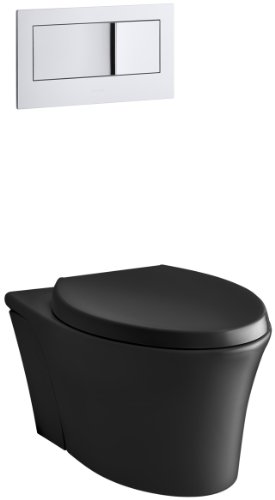
8. KOHLER Veil K-6299 – Compact Wall-Hung Toilet
The KOHLER Veil K-6299 creates a tankless appearance because its flushing tank is hidden inside the wall.
However, it’s important to understand that this model isn’t truly tankless. It requires a compatible in-wall tank and carrier system, plus a flush actuator plate.
The wall-hung design leaves the floor underneath the bowl accessible, making cleaning easier.
It also provides a compact elongated bowl that offers additional seating comfort without extending as far into the room as some conventional elongated toilets.
The seating height depends on the carrier installation, so it can be positioned according to the supported range and applicable requirements.
Key Features:
- Wall-hung vitreous china construction.
- Compact elongated bowl.
- Concealed mounting hardware.
- Compatible dual-flush in-wall tank system.
- Adjustable installation height within carrier limits.
Pros: Modern appearance, accessible floor underneath, and compact design.
Cons: Requires additional concealed components and professional installation.
Best for: Small contemporary bathrooms where wall construction allows an in-wall carrier.
 Check Price and Availability
9. Duravit Starck 3 – Minimalist Wall-Mounted Toilet
The Duravit Starck 3 is another attractive option for homeowners who want a clean, wall-mounted bathroom design.
Its simple ceramic shape can match both modern and traditional bathrooms.
Like other conventional wall-hung toilets, it needs an appropriate in-wall carrier and flushing tank. It should not be treated as a direct-supply tankless toilet.
One advantage of wall-mounted installation is that you can clean the floor underneath the bowl without navigating around a toilet pedestal.
However, installation requires careful planning. The wall structure, carrier specifications, waste outlet, and plumbing access must all be considered.
Key Features:
- Wall-mounted ceramic bowl.
- Minimalist exterior design.
- Compatible concealed-tank installation.
- Accessible floor underneath.
- Seating height determined during installation.
Pros: Attractive design, convenient cleaning, and flexible bathroom planning.
Cons: Additional carrier and tank costs, with more complex installation.
Best for: Bathroom renovations where a concealed-tank toilet is part of the original design.
 Check Price and Availability
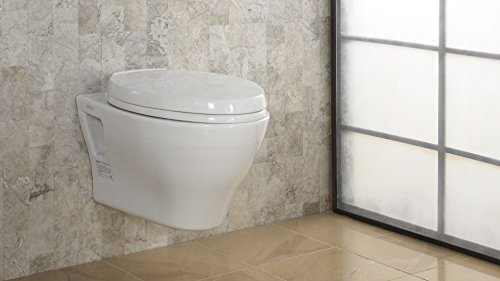
10. TOTO Aquia CT418FG – Wall-Hung Dual-Flush Toilet
The TOTO Aquia CT418FG is designed for wall-hung installation with a compatible concealed tank.
Its elongated bowl and smooth exterior provide a modern appearance while leaving the bathroom floor accessible for cleaning.
With the appropriate tank configuration, the dual-flush system uses approximately 0.9 or 1.6 GPF.
This model is worth considering if you want a wall-mounted toilet without investing in advanced electronic features.
Remember that the bowl itself isn’t a complete installation package. The carrier, tank, flush plate, and potentially the seat may need to be purchased separately.
Key Features:
- Wall-hung vitreous china bowl.
- Elongated seating design.
- Compatible dual-flush system.
- Concealed-tank installation.
- Accessible floor underneath.
Pros: Modern design, efficient flushing options, and easier floor cleaning.
Cons: Additional installation components and possible parts availability concerns.
Best for: Homeowners who prefer a conventional wall-hung toilet with dual flushing.
Compare other designs in our wall-hung toilet buying guide.
 Check Price and Availability
Tankless Toilets: Complete Buying Guide
After reading our best tankless toilet reviews, you may already have a favorite. However, there are a few things I suggest checking before making your final decision.
1. Water Supply Pressure and Flow
This is one of the most important considerations for genuine tankless toilets.
Unlike a conventional gravity toilet that stores water in a tank, some tankless models need a specific water supply flow rate to flush correctly.
For example, KOHLER specifies minimum supply-flow requirements for the Veil K-5401.
If your bathroom plumbing doesn’t meet the requirements, you may experience poor flushing performance or need plumbing modifications.
2. Electrical Requirements
Many smart toilets need a suitable electrical outlet for heated seating, bidet functions, sensors, and automatic operation.
Macerating models also require electrical power to operate their pumps.
Before installation, confirm the voltage, outlet requirements, and any applicable electrical safety requirements.
Never assume that an electronic toilet will flush normally during a power outage. Backup operation varies by model.
3. Bathroom Dimensions
Tankless toilets can save visual space, but not every model is physically smaller than a conventional toilet.
Check the complete toilet dimensions, including width, depth, height, and required clearances.
For small bathrooms, compare the actual measurements rather than relying on the word compact.
4. Installation Cost
A conventional floor-mounted toilet replacement is often simpler than installing a direct-supply smart toilet or wall-hung system.
Wall-hung toilets may require opening the wall, installing a carrier, relocating drainage, and adding a concealed tank.
Macerating toilets require discharge piping and electrical connections.
The complete installation cost can therefore be considerably higher than the toilet’s advertised purchase price.
5. Water Consumption
Don’t assume every tankless toilet uses less water than a regular toilet.
Modern conventional toilets can also offer efficient flushing at 1.28 GPF or lower.
Compare the manufacturer’s water-consumption specifications and look for applicable certifications.
Our low-flow toilet guide explains water-saving alternatives.
6. Smart Features
Features such as heated seats, warm-water cleansing, deodorization, and automatic flushing can make a bathroom more comfortable.
However, every additional electronic component introduces another part that may eventually require servicing.
Choose the features you’ll actually use instead of paying extra for unnecessary technology.
7. Replacement Parts and Warranty
Replacement-part availability is especially important for older integrated smart toilets.
Before buying a discontinued or older model, check whether the manufacturer still supplies compatible control boards, sensors, pumps, and other components.
Also review the current warranty terms for the exact product being sold.
Floor-Mounted vs. Wall-Hung Tankless-Style Toilets
| Feature | Floor-Mounted | Wall-Hung |
|---|---|---|
| Installation | Depends on supply and drain connections | Requires suitable wall carrier and concealed plumbing |
| Floor Cleaning | Must clean around the base | Open floor beneath bowl |
| Appearance | Traditional or modern | Minimalist and floating |
| Weight Support | Supported by floor installation | Supported by engineered wall carrier |
| Seat Height | Determined by product design | Set within carrier’s supported installation range |
| Installation Cost | Often lower for standard replacements | Often higher due to concealed components |
Neither option is automatically better. Floor-mounted toilets may be more practical for straightforward replacements, while wall-hung toilets offer a cleaner floor area and a distinctive appearance.
Always follow the mounting system’s rated load and installation instructions.
Are Tankless Toilets Worth the Money?
A tankless toilet can be worth the investment if its design and features solve a real problem in your bathroom.
For example, a Saniflo Sanicompact may make an additional basement bathroom possible without extensive gravity-drain construction.
A KOHLER Veil smart toilet may appeal to someone who wants electronic cleansing and an elegant design.
However, if your only goal is reliable flushing, a well-designed conventional toilet may be more affordable and easier to maintain.
That’s why I recommend comparing the complete ownership cost rather than focusing only on appearance or luxury features.
Common Tankless Toilet Problems
Like any plumbing fixture, tankless and integrated toilets can develop problems over time.
Weak or Incomplete Flushing
Insufficient supply pressure or flow, a blocked inlet filter, or a flushing component problem may affect performance.
Check the manufacturer’s troubleshooting instructions before adjusting any plumbing connections.
Electronic Features Stop Working
A power supply issue, damaged sensor, or failed electronic component may prevent automatic features from operating.
If the toilet stops responding, check the power supply and any reset procedure described in the manual.
Macerating Pump Problems
Macerating toilets can become blocked if inappropriate materials are flushed.
Only flush materials approved by the manufacturer. Avoid wipes, sanitary products, and other non-flushable objects.
Unexpected Water Leaks
Leaks may come from supply connections, seals, discharge piping, or internal components.
If you notice water around an electronic toilet, stop using it and follow the manufacturer’s safety instructions before troubleshooting.
Frequently Asked Questions
1. What is the best tankless toilet for residential use?
The best choice depends on your plumbing, budget, and desired features. KOHLER Veil K-5401 is worth considering for a modern direct-supply smart toilet, while Saniflo Sanicompact is useful for locations with difficult drainage.
2. Do tankless toilets need electricity?
Some do, but not all. Integrated smart toilets and macerating systems generally need electrical power for their electronic features or pumps. Certain commercial direct-flush systems operate without electricity.
3. Can I replace my standard toilet with a tankless toilet?
Possibly, but the existing water supply, drain connection, electrical access, and bathroom dimensions must be suitable. Some installations require significant plumbing modifications.
4. Are tankless toilets better for small bathrooms?
Some compact and wall-hung models work well in smaller bathrooms, but you should compare the actual dimensions. A toilet without a visible tank isn’t necessarily shorter or narrower than a conventional model.
5. Do tankless toilets save more water?
Not automatically. Water consumption depends on the flushing system. Some tankless models use very little water, but many modern conventional toilets are also water-efficient.
6. How long does a tankless toilet last?
The ceramic fixture can last for many years with proper care. Electronic components, sensors, pumps, and seals may need repair or replacement sooner. Lifespan depends on the model, installation, water conditions, and maintenance.
Final Thoughts
Our best tankless toilet reviews show that there isn’t one perfect model for every bathroom.
If you want advanced smart features, the KOHLER Veil and integrated TOTO Neorest models are worth considering. If you’re adding a bathroom where conventional gravity drainage is difficult, the Saniflo Sanicompact offers a different solution.
For a minimalist wall-mounted design, KOHLER Veil K-6299, Duravit Starck 3, and TOTO Aquia are alternatives worth comparing. Just remember that these models require concealed tanks rather than operating as genuine tankless toilets.
My recommendation: Check the water supply, drainage, installation requirements, product availability, and long-term servicing costs before buying.
A good tankless toilet should do more than look impressive. It should fit your bathroom, provide reliable flushing, and remain practical to maintain for years.

Hi, this is Robert Crossan, the owner of this website, has 17 years of experience in the installation, maintenance, and repair of toilets and plumbing systems. After completing the Level 2 Basic Plumbing course in 2005, I started working in both domestic and commercial buildings as a professional plumber. So I can figure out the core difference between different toilet models and brands. It also helped me monitor their work performance and setbacks.